The emergence of digital technologies, cloud computing, and Internet-of-Things devices in organizations has led to the concomitant emergence of complex cyber threats. Traditional cybersecurity measures that rely on static rules might not ensure effective detection of today’s rapidly evolving attacks.
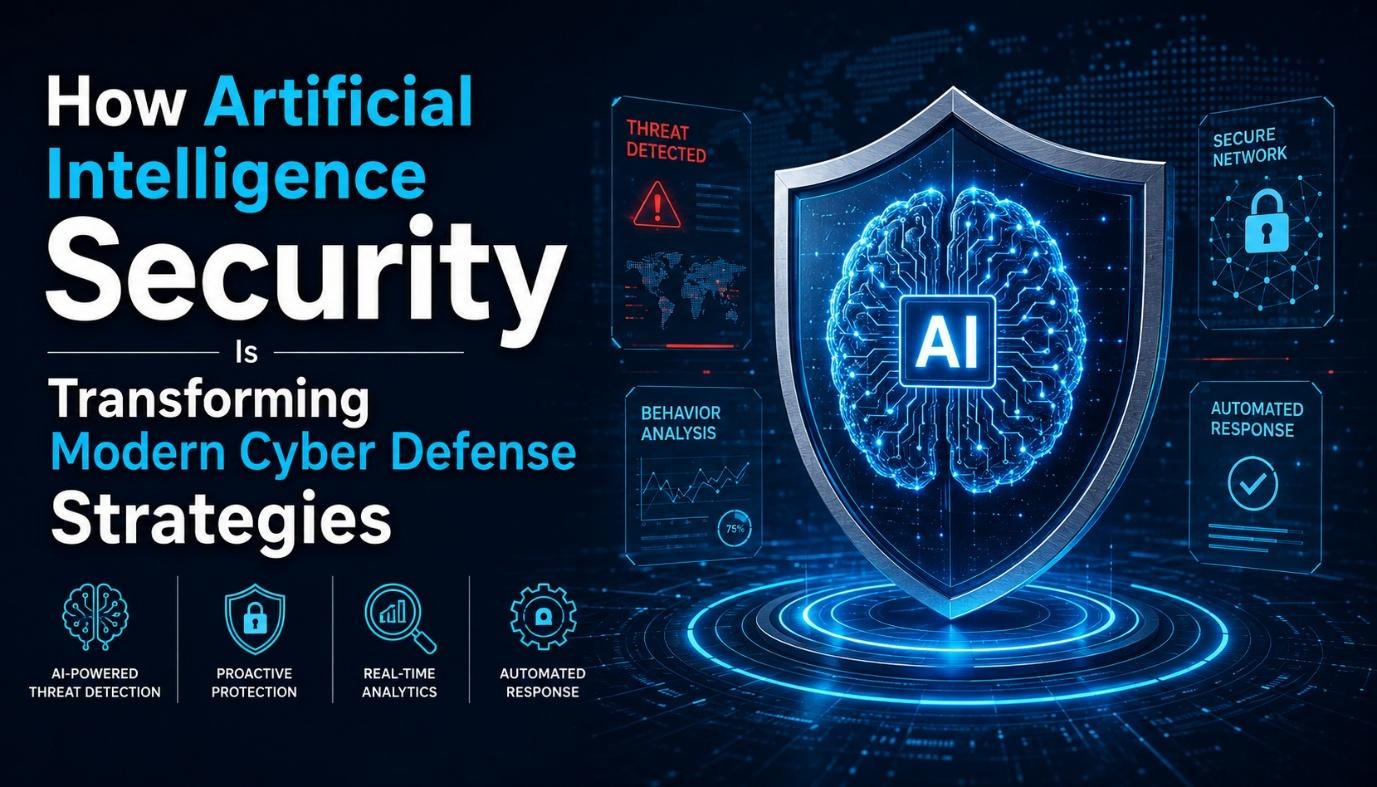
The introduction of Artificial Intelligence Security has changed the game in regard to the functioning of cybersecurity strategies with the help of capabilities necessary for the rapid identification of threats, the automation of response processes, and increased efficiency of threat evaluation.
Cybersecurity studies show that global expenses on cybercrime will reach around $10.5 trillion per year by 2025. Thus, the pace of changes in cyber threats will push companies to move to more advanced ways of fighting cybercrimes. This is done thanks to artificial intelligence that allows teams to analyze big amounts of data, detect unusual activities, and react to threats more effectively.
Read: How AI is Shaping the Future of SEO in Digital Marketing
The Importance of Artificial Intelligence in Cyber Security
The technology of artificial intelligence facilitates access to contemporary security systems due to its efficiency in analyzing enormous quantities of information on a real-time basis. Corporate networks create thousands of security activities every day, including computer login attempts, changes to the IT system, and traffic on the networks. Manual processes cannot keep up with such enormous amounts of security data anymore.
The introduction of AI-based security solutions has been manifested in the growing artificial intelligence security market. As noted by DataIntelo, the global market for artificial intelligence security systems was worth $18.3 billion in 2025, with a forecasted compound annual growth rate (CAGR) of 21.5% until 2033, with the market size estimated to reach approximately $87.9 billion. Such growth of the market indicates a rapidly growing need for intelligent solutions for cyber security.
abnormal activities. Studies show that companies that implement AI-powered security solutions can attain a reduction of almost 60% in threat reaction time compared to conventional methods of threat protection.
Such tools assist the security function in reviewing:
- Traffic flow and traffic anomalies
- Changes in user’s behavior and authentication threats
- Attack signs and infection characteristics
- Vulnerabilities in systems and their settings
With the help of regular learning from new data, AI security technology chances of identification of new threats is constantly improving.
Threat-Finding and Response via Artificial Intelligence
Artificial Intelligence has fundamentally changed the way threats are detected in security. Traditional cyber-security solutions rely on cached signatures of known threats, which makes it hard for them to detect new types of malware attacks.
AI systems observe users’ behavior patterns, not merely use the previously known threats for detection. Thus, a sudden access to unusual documents by some user or an unexpected data transfer would be considered as suspicious.
According to a cybersecurity survey conducted in 2024, about 70% of businesses state that faster threat detection is a major benefit of the implementation of artificial intelligence in the field of cybersecurity.
| Cybersecurity Function | Traditional Approach | AI-Driven Approach |
| Threat Detection | Signature-based identification | Behavioural & predictive analysis |
| Response Speed | Manual investigation required | Automated response within seconds |
| Data Analysis | Limited by human capacity | Processes millions of events continuously |
| Risk Assessment | Periodic security reviews | Real-time risk evaluation |
Recognizing Being Safe During Advanced Cyber Attacks
Today’s hackers are leveraging technological advances, techniques of social engineering, and sophisticated malware to commit their acts. Fortunately, organizations can turn to artificial intelligence for protection.
Artificial intelligence can identify trends from a variety of data formats such as end-user behavior, network logs, and endpoint activities. By doing so, organizations will be able to defend against attacks like ransomware and phishing.
Statistics indicate a more than 70% increase in ransomware incidents from 2022 to 2024, which shows the need for solutions for detecting threats before serious damage occurs.
The AI Security solution aids in taking preventive measures by revealing the probable paths of attack using risk analysis technique, identifying vulnerable systems even before they are exploited, detecting abnormal patterns of access, and automating the entire process of incident investigation.
With the help of these applications, the security teams are in a position to move away from merely reacting to threats and start employing some proactive protection strategies.
AI Security Issues and Risk Factors
While the use of AI positively influences cybersecurity, it brings its own challenges. Cybercriminals learn to exploit AI systems, produce more advanced phishing campaigns, and evade automated protection mechanisms.
The quality of data plays a very important role in determining the success of AI security systems. If the quality of data is not good enough, AI algorithms may make erroneous conclusions. Lack of sufficient quality of data may cause the failure to identify threats correctly, or even miss safety issues.
Another risk refers to the security of the AI models in use. Security specialists should make sure that AI systems are protected against manipulation via various methods, such as data poisoning and adversarial attacks.
Research in the field of cybersecurity illustrates that about 45% of companies view AI model AI-Powered Cyber Defense
What Lies Ahead
The future of cybersecurity is probably going to see more collaboration between AI and human skills. AI is good at performing huge amounts of data analysis and repeating security tasks while cybersecurity specialists deal with making choices and solving complex issues.
The demand for AI-based cybersecurity solutions is expected to increase significantly by 2030. As companies enhance investments in their digital technologies and infrastructures to tackle new cybersecurity challenges, they will need more efficient solutions.
Some of the anticipated trends are:
- Improved threat prediction techniques
- Better automated incident response
- Security improvement of AI technologies
- Better integration of cybersecurity solutions
The emergence of AI in cybersecurity is a developing trend. However, AI cannot substitute people’s knowledge and experience in this area but only assist companies in threat detection, processing huge amounts of information, and securing their systems from cyber threats. The nature of cyber attacks does change, so it is crucial for companies to move with technology and combine AI with human knowledge.