

B2B lead generation is no longer just about ranking on Google or sending more outreach emails. As AI transforms how buyers discover, evaluate, and engage with businesses, companies must rethink every stage of their lead generation strategy. From AI-powered search experiences to predictive lead scoring and personalized outreach, the rules are changing faster than ever.
Outreach gets written (or at least drafted) by language models. Even the way prospects find companies has changed, because a growing chunk of them aren’t searching Google the old way anymore, they’re asking an AI assistant to do the research for them. None of this happened overnight, and honestly, a lot of it is still messy. But the shift is real, and it’s worth breaking down properly instead of just throwing around buzzwords like “AI-powered growth” (which, let’s be honest, shows up on every SaaS landing page these days whether it’s earned or not).
AI Is Rewriting How Companies Acquire Customers
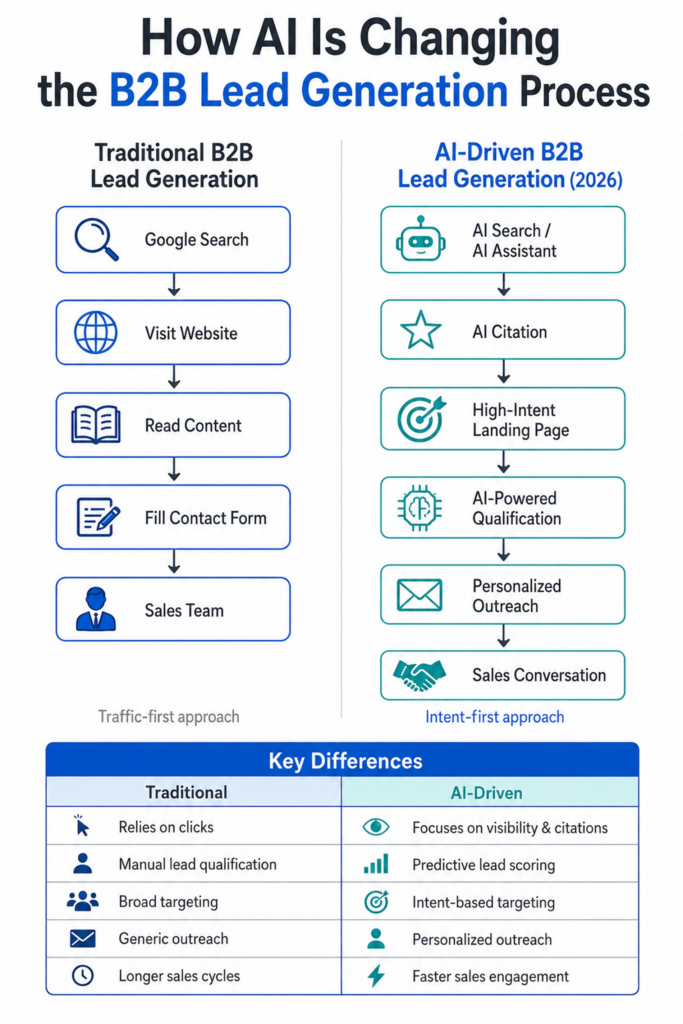
The biggest change isn’t that AI writes emails now, that’s the surface-level story. The deeper shift is in how customer acquisition gets prioritized. Sales and marketing teams used to spend enormous energy just figuring out who to talk to. Now predictive lead scoring models chew through firmographic data, intent signals, website behavior, and even hiring trends to flag which accounts are actually worth a rep’s time this week.
That matters because B2B sales cycles are long and expensive to run. A mid-market SaaS company might have a sales team of six people and thousands of possible target accounts. AI doesn’t replace the judgment call on who to pursue, but it narrows the field dramatically, so reps stop cold-emailing companies that were never going to buy in the first place.
There’s also a quieter transformation happening around buyer research. A lot of B2B buyers now start their vendor research inside AI chat tools rather than typing a query into a search bar and clicking through ten blue links. That means the traditional funnel — awareness, consideration, decision — still exists, but the entry point has moved. Businesses that show up clearly and credibly in AI-generated answers have an advantage before a prospect ever visits their website.
This shift is already showing up in search behaviour. According to Bain & Company, around 80% consumers now rely on zero-click results for at least 40% of their searches, meaning many users find the information they need without ever visiting a website. As AI-generated answers become more common, brands need to focus on earning visibility within those answers—not just ranking for traditional search results.
Read: How Artificial Intelligence Security Is Transforming Modern Cyber Defense Strategies
SEO Still Matters — Arguably More Than Before
Here’s something that trips a lot of marketers up: they assume AI search killed SEO. It didn’t. It changed what good SEO looks like. AI answer engines and AI Overviews pull from the web to generate their responses, which means the underlying content still has to exist, still has to be trustworthy, and still has to be structured in a way that both humans and machines can parse. If anything, the bar for content quality went up, not down. Thin, keyword-stuffed blog posts that used to sneak into page one are getting buried, while specific, experience-backed, clearly organized content is what’s actually getting cited and surfaced.
The impact is becoming measurable. Research cited by HubSpot found that when Google displays AI Overviews, average outbound organic clicks can drop by 38%, reinforcing why businesses must optimize for authority, citations, and answer quality rather than relying solely on traditional rankings.
This shift also reinforces why businesses need to stay informed about how AI is reshaping search and digital marketing. Tech Tool Help has published several practical resources on AI and emerging technologies that complement these changes, helping readers understand how new tools are influencing everything from content creation to business growth.
For B2B brands specifically, this shift rewards content tied to real buying intent rather than generic “what is X” articles that never move anyone toward a purchase decision. A page built around a specific service, industry, or comparison, the kind of page someone lands on when they’re actually evaluating vendors, tends to perform far better than a broad educational post that gets summarized by an AI tool before anyone clicks through.
Many B2B agencies have shifted toward building search visibility around commercial-intent pages rather than chasing informational traffic alone. This approach helps attract prospects who are actively evaluating solutions rather than simply researching a topic.
The practical takeaway: if your SEO strategy in 2026 still looks like “publish more blog posts,” it’s probably underperforming. If it’s built around answering the exact questions high-intent buyers are asking — including the questions they’re now asking conversational search platforms directly — you’re in a much stronger position.
“AI is changing how buyers discover businesses, but trust is still earned through useful authoritative content.”
Outreach Automation and Personalization Have Gotten Genuinely Good
For years, “personalized” outreach meant a mail merge with someone’s first name and company inserted into a generic template. Everyone could tell. Open rates reflected it. That’s changed meaningfully. AI-driven sequencing tools can now pull in a prospect’s recent LinkedIn activity, funding news, job postings, or even specific pain points mentioned in a case study they downloaded, and use that to draft outreach that actually reads like it was written for one person. It usually still needs a human pass before it goes out, the best sales teams treat AI drafts as a first cut, not a final product, but the time savings are substantial.
Where this gets interesting is in the layering. Modern outreach platforms don’t just personalize a single email; they build out entire multi-touch sequences across email, LinkedIn, and sometimes even direct mail, adjusting tone and timing based on how a prospect engages. Someone who opens three emails but never clicks gets a different follow-up than someone who visits the pricing page twice. That kind of behavioral responsiveness used to require a dedicated ops person watching dashboards all day. Now it happens automatically, in the background, while the sales team focuses on actual conversations.
Where Businesses Keep Getting It Wrong
Not everything about this shift has been smooth, and it’s worth being honest about where businesses trip up.
- Over-automating too early: Some teams get access to AI tools and immediately try to automate the entire funnel, research, outreach, follow-up, even initial qualification calls. The result is often outreach that’s technically personalized but still feels hollow, because there’s no human judgment checking whether the message actually makes sense for that specific buyer.
- Treating AI content as a shortcut instead of a starting point: This is probably the most common mistake in the SEO side of things. Companies generate a pile of AI-written articles, publish them with minimal editing, and wonder why rankings don’t move; or worse, why traffic actually drops. Search engines and AI crawlers alike have gotten much better at recognizing generic, low-effort content, and thin AI output tends to get filtered out rather than rewarded.
- Ignoring data quality: AI lead scoring and personalization are only as good as the data feeding them. A CRM full of outdated contacts, duplicate records, or vague firmographic data will produce confidently wrong recommendations. Garbage in, garbage out hasn’t gone anywhere just because the tools got smarter.
- Skipping the human review step in outreach: AI-drafted messages occasionally get facts wrong or misread context, referencing a “recent product launch” that happened two years ago, for instance. It’s easy to get pulled into buying five different AI platforms because each one promises a growth breakthrough. The businesses actually seeing results tend to pick fewer tools, integrate them properly, and build a coherent process around them, rather than stacking disconnected point solutions.
Tools and Strategies Companies Are Actually Using Right Now:
On the practical side, a few categories have become fairly standard in serious B2B lead gen operations this year:
- Intent data platforms that track which brands are researching relevant topics or competitor products, giving sales teams a heads-up before a prospect even fills out a form.
- AI-assisted sequencing tools for outreach that personalize messaging at scale while still routing final approval through a human rep.
- Conversational AI on websites, not the clunky chatbots of a few years ago, but tools that can actually qualify a visitor, answer specific product questions, and route them to the right sales rep or resource.
- Predictive lead scoring built into the CRM itself, so reps aren’t manually triaging every inbound lead.
- AI-optimized content and SEO strategy, focused on structuring pages so they’re both readable for humans and easily parsed by AI search tools, with real emphasis on the commercial, decision-stage pages that actually drive pipeline rather than just traffic.
None of these tools work in isolation, and none of them replace the fundamentals of good positioning, a clear value proposition, or an actual sales process. What’s changed is how much manual grunt work has been stripped out of getting a message in front of the right person at the right time.
Where This Is Headed:
The honest answer is that nobody has this fully figured out yet, including the companies selling the tools. What’s clear is that AI has moved from being a novelty to being an essential part of how B2B organizations attract, qualify, and engage potential customers. The businesses seeing the strongest are combining smarter AI tools with fundamentals: understanding their buyers, building genuine authority, and creating content that earns trust rather than simply chasing rankings.
For organizations looking to strengthen their long-term search visibility, investing in a well-planned B2B SEO strategy can complement AI-driven marketing efforts and help generate sustainable, high-intent leads as search continues to evolve. AI is changing how businesses discover customers, qualify opportunities, and earn visibility online. Businesses that adapt their SEO, content, and outreach strategies today will be far better positioned as AI-driven search continues to evolve.