

Back-end development is basically the foundation of any web application in order for it to run efficiently and/or effectively. Whether you are talking about an eCommerce website that processes thousands of transactions on a daily basis, a health care portal that securely holds sensitive data relative to patients, or software as a service that serves customers from around the globe, the performance and scalability of a web application will always be dependent upon the quality of the back end.
When companies understand the basic principles of back-end development, they can better understand what modern data-driven web applications provide to allow for increased user demand, while also protecting the sensitive information contained within this same web application.
Back-End Development Explained
The development of the back end of a website refers to the server-side components of a website that users cannot see directly but are essential for processing requests/environments, retrieving data, as well as for authentication and application logic. For the website to work properly, systems must work together in a coordinated manner. Each of these systems refers to each other by name throughout their respective environments.
A web application’s back-end typically consists of three main components:
1) Servers – are the equipment used to host and process incoming customer requests, deliver responses to customers, and store backup copies of all customer-related data.
2) Database – is the application that contains and stores all customer-related data.
3) Application Logic – contains the programming code that creates a user’s experience.
A typical web application’s back-end will include several different technologies:
- Node.js
- Python
- Java
- .Net
- PHP
- Ruby
These technologies enable back-end databases, such as:
- Postgres
- MySQL
- MongoDB
- SQL Server
In conclusion, when systems work together as one, they create an engine that runs a full-fledged web application powered behind the scenes by these types of systems.
Read: The Ultimate Guide to ERP and WMS Integration for Seamless Fulfillment
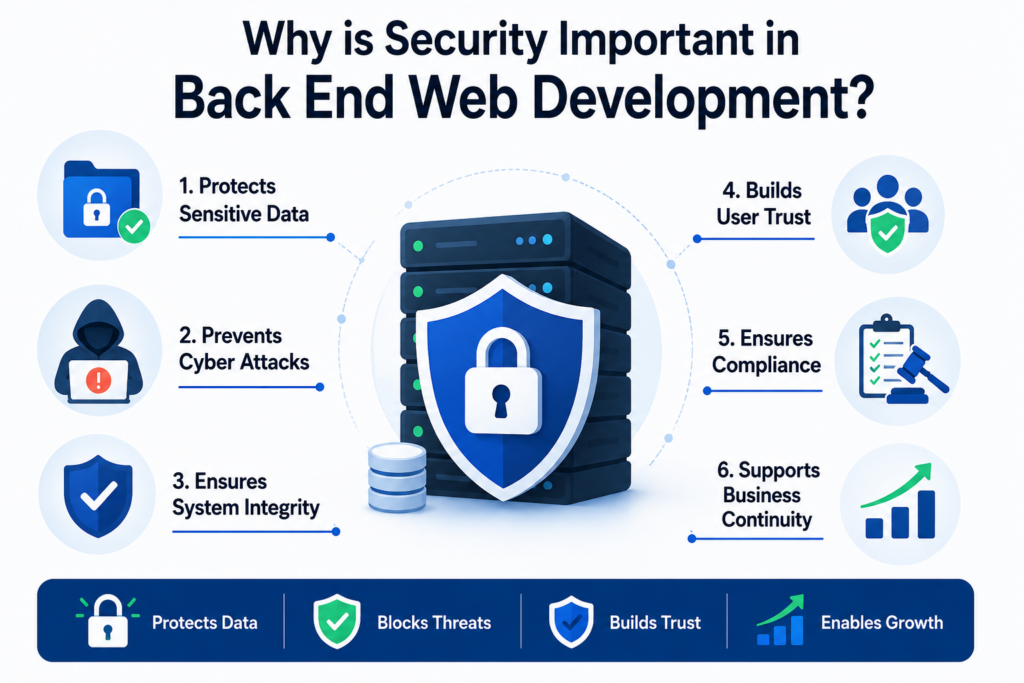
Why is Security Important in Back End Web Development?
The number of cyber attacks has increased tremendously over the past few years as has their sophistication. Organizations that fall victim to various types of attacks including data breaches, ransomware, and unauthorized access face various consequences, including financial loss, legal liability and damage to their reputation.
For organizations that store sensitive data and perform mission-critical functions on the back end, security should be considered at every phase of the application development lifecycle so that it becomes an integral part of all products being built.
Secure Authentication and Authorization
Authentication and Authorization are key areas when it comes to application security. These are two key factors in ensuring only authorized users can access certain resources. Authentication is how we verify the identities of users, such as by using a password, multi-factor authentication (MFA), or single sign-on (SSO). Authorization determines what an authenticated user is allowed to do once they have logged in.
Most organizations primarily use role-based access control (RBAC) to define user roles and responsibilities. RBAC limits the number of users that can access resources that they do not need to perform their jobs, and consequently, reduces the potential for accidental or malicious misuse.
Data Encryption
Protecting confidential data, such as credit card numbers, by both encryption and Transport Layer Security (TLS) helps to protect data from being intercepted by hackers when sent over the internet. Encryption of previously stored data ensures that the data remains encrypted and cannot be read if someone gains unauthorized access to the database.
Encryption is particularly important for any application that deals with personal information (such as social security numbers), as well as financial and health-related information.
Protection Against Common Vulnerabilities
The back-end developer should also implement protections to guard against common types of attacks, such as:
- SQL injection;
- Cross-site scripting (XSS);
- Cross-site request forgery (CSRF);
- Broken authentication; and
- Healthcare application (API) abuse.
Some of the ways in which developers protect against these types of attacks include Input Validation; using Parameterized Queries for Database Queries; using Secure Session Management Techniques; and Performing Regular Security Testing.
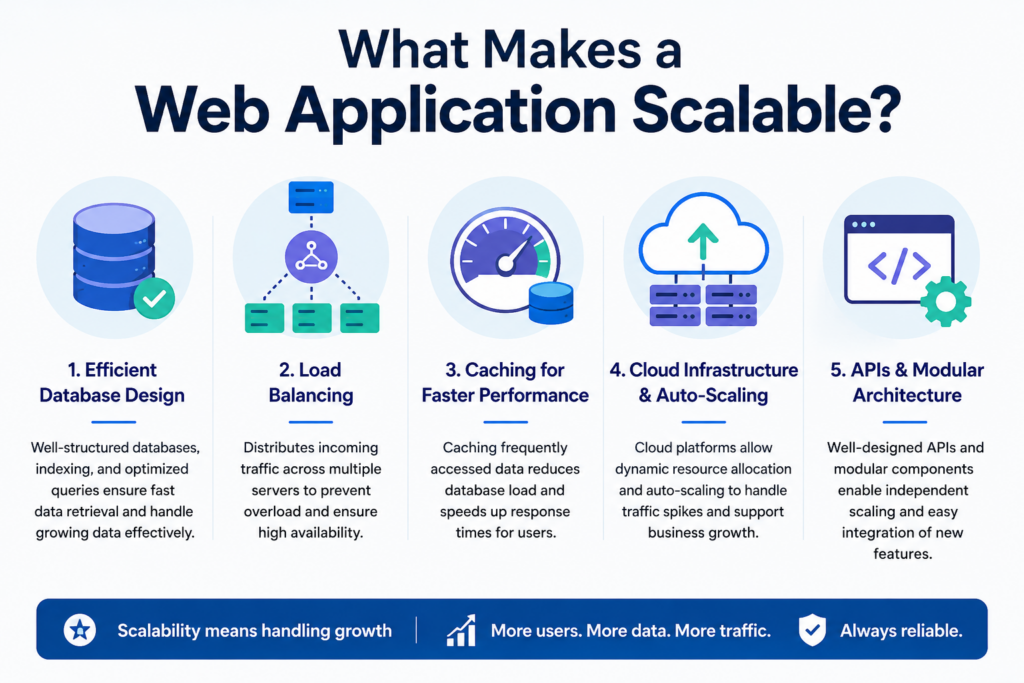
What Makes a Web Application Scalable?
Scalability is defined as an application’s ability to provide performance and dependability as its workload increases.
As companies onboard more users, process more transactions, and store larger amounts of data, their applications must be able to accommodate the increased demand.
Having a scalable back-end solution enables businesses to expand without having to constantly redevelop their technology infrastructure.
Creating Efficient Databases
When applications are subjected to very rapid growth, databases will frequently become a bottleneck for performance.
When the underlying structure of a database is well-designed, then databases can enhance performance by giving data a well-organized structure and minimizing unwanted action on data. Things like indexing, optimizing queries and normalizing databases are three techniques that help deliver the needed speed of retrieving the data.
If the system continues to grow, businesses may want to implement database replication or sharding (i.e. distributing data across many servers) to help distribute data across many servers.
Load Balancing
Rather than have all requests directed toward one server, scalable applications use load balancers to distribute their request to multiple servers.
In doing so, it helps keep each individual server from becoming overwhelmed and increases the overall availability of the system. If one individual server were to experience a problem, the load balancer could redirect the requests to those other servers that were still healthy, reducing downtime.
Reliable load balancing is an essential part of all current applications that experience very high amounts of traffic, such as web-based applications.
Using Caching to Improve Performance
Many applications continually process the same requests or use the same data when returned from an application’s databases.
The use of caching allows for this information to be quickly retrieved without having to keep asking the database for those responses. Solutions such as Redis and Memcached are both commonly used technologies for speeding up applications and reducing the load on the server.
Once implemented, effective caching will significantly improve both the user’s experience and the scalability of your application.
Balancing Security and Scalability
Security and scalability are often viewed as opposing forces, but both are essential components of successful web applications. A highly scalable application without proper security provides businesses with ample risk exposure. Similarly, extremely secure applications but with no scalability prevent business growth.
Modern back-end development strives toward building architectures that will provide strong security controls and sufficient flexibility to scale correctly. Building strong security practices, leveraging cloud-native technologies, automating where possible, and continuously monitoring application performance and security are all important components of modern back-end development.
In conclusion
Back-end development is the building block of a successful web application. It is responsible for storing and managing data, processing business logic, enabling systems to work together, and ensuring users have reliable and secure access to services.
With the growing trend towards digital platforms to service customers and generate profits, now more than ever before, investing in secure and scalable backend development services is important to the business’s long-term success.